Friday, September 25, 2015

What is my bike commute like?

Someone on bikeforums asked whoever would answer what our commutes are like. He asked about terrain, length, clothing, time constraints. Here is the response I wrote.

I commute from near the southern end of Manhattan (south of 14th St), to the northern end and beyond into the Bronx. I work at 238th St. In NYC, 20 blocks is one mile. The total distance is 13 or 14 miles, depending on the route I choose. It's a very urban commute, but I'm very lucky, because most of it is along the Hudson River Greenway, the US's most heavily used bike commuting route. I don't know how many cyclists I pass, but it's several hundred. After 125th St, there aren't as many bike commuters, and very few are going in my direction. The route is mostly flat, as it's along the river, on a part of the island that is landfill. It is also a pretty noisy route, as it is almost completely next to a highway. Headwinds in the morning can be very strong. Towards the end of the route, I hit a killer hill and then some lesser hills. The killer hill isn't long, but it's steep. The last couple of miles is in motor vehicle traffic. Most of you all would call it heavy traffic, and it is, but it's a lot lighter than it is in Midtown Manhattan, where it is insane beyond belief. Thank goodness I don't have to ride in Midtown often.

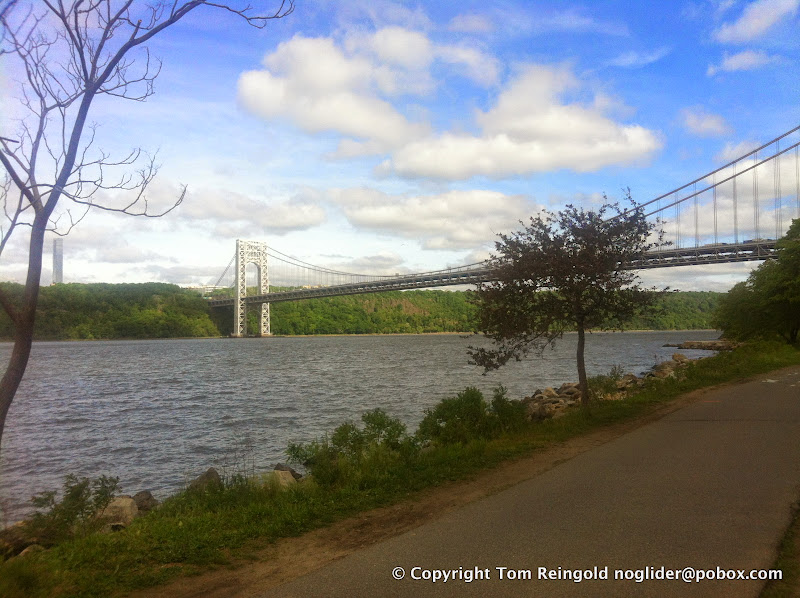
The route is terribly scenic. The Hudson River is over a mile wide. New Jersey is on the other side, with cliffs facing the river. Also along the path are some very good looking people riding their bikes and jogging, so that's another kind of pleasant scenery.
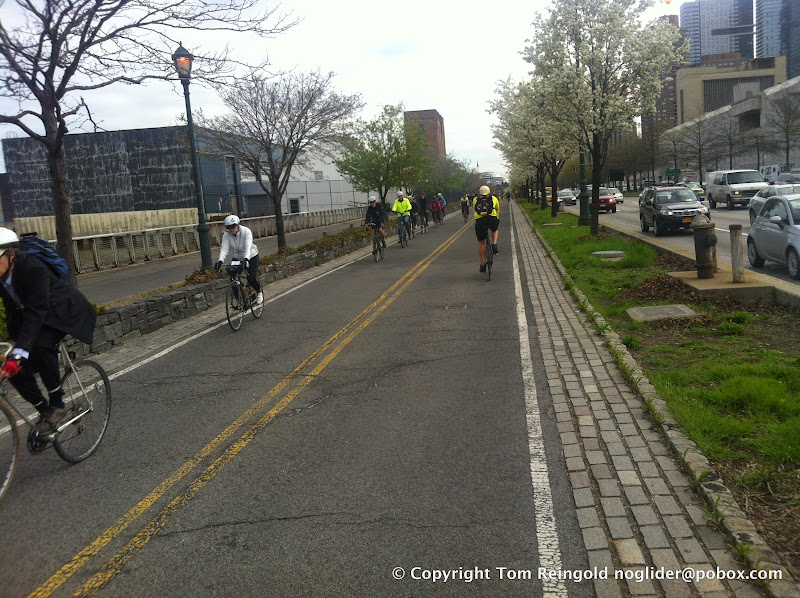


If I'm lucky, on my ride home, the wind hasn't shifted to become a headwind. It happens sometimes. Usually the direction is the same but the intensity is less, so I don't get as much of a boost going home as a challenge I have in the mornings. In the winter, the riverside is colder than the rest of the city, and boy, is it cold and windy. I'm going to try riding in heavy boots this winter.

I'm supposed to be dressed somewhat conservatively at work. Jeans are officially not allowed but are tolerated. I don't care, as I don't like jeans any more. Men aren't supposed to wear sandals, which I think is dumb, but those are the rules. Polo shirts are OK, and they are my favorite type of shirt. I usually wear my work clothes on the bike. Sometimes I'll ride in wearing shorts, and I'll change upon arrival. When I ride, I usually wear sneakers with SPD cleats on them. I don't know if they are allowed, but no one has complained.


My kids are adults, and my wife often works in the evenings, so I often have no reason to rush home.

I ride my bike to work about two days a week. The other three or so days I take the subway, which has its upsides. It is relaxed. I'm headed against traffic, so it's not terribly crowded. I get to read. The subway ride takes the same amount of time as the bike ride, so my decision of which mode to use isn't based on time. I also get to look at all the different people, which I enjoy. New York is a great city for people watching. I think I might see a thousand faces in a day. Stop and think about that. How many faces do you see in a day?


Tuesday, September 15, 2015

Parents don't want a Citi Bike station near their kids' school

I don't understand their concerns. Why are cyclists more of a threat to children than adults on foot or in cars? Why is a child more likely to bump into a parked bicycle and get hurt than into any other fixed object?
Citi Bike Station in UES School's Play Space Is a Hazard, Parents Say

Thursday, November 13, 2014

Hudson River bike path, Garmin profile

I was on the Hudson River Greenway bike path today at around midday. The sky was grey, and the humidity was rising rapidly, which made for a nasty feeling, though it wasn't brutal at all. I was surprised to see how empty the path was. I'm sure the lull was related to the middle of the day between rush hours, but still, I think today marks the time when many cyclists decide not to ride for the rest of the time from now through winter. Sorry, but I can't bear to call November the winter. It's too depressing.

I plan to keep riding this winter, and I plan to toughen up a bit. I'm interested in seeing how comfortable I remain in bad weather by dressing for the conditions.

In looking up the Hudson River Greenway, I came upon this web page, for the Hudson River Park. The bike path runs through that park and beyond. The first sentence is:

The Hudson River Park Bikeway is the busiest in the United States.

Wow. I shouldn't be surprised, but I am impressed. Sometimes, I get a question on bikeforums, such as "How often do you see a bike commuter on your route?" The question is odd to me, because I can see dozens at any given moment. How often do I not see a bike commuter, would be a better question.

I don't remember if I mentioned that my Garmin public profile is here. In theory, you can see all the rides I take. In practice, I don't always carry my Garmin device. I haven't used it for ten days, but actually, I ride several times a week. I think I better get back into the habit, because I'm interested in keeping a good tally of my total miles. I thought I would want to review things like top speed and average speed, but as more data comes in, the little details become less interesting.

Thursday, October 2, 2014

Stop demonizing “bike culture”!

No group of people is perfect, and that certainly includes cyclists. But I am troubled by the depiction of cyclists as a huge problem, even when people acknowledge that not everyone rides dangerously. Let's put the problems in perspective. When you are crossing the street on foot and a cyclist passes by too quickly, perhaps illegally, it is annoying and scary. We should solve this problem with better facilities and training and enforcement. But let's not lose sight of the fact that danger from cars is hundreds of times greater. We don't notice that because it has been present (and therefore normal) for a long time. But it's not very rational to discount the bigger danger merely because we're accustomed to it.

Please read this piece from Salon. It expresses how I feel pretty well. I hadn't even thought of why the current facilities encourage us to break laws. It's not just the facilities, it's the general chaotic nature of New York traffic. We have to adapt minute by minute and second by second. Survival and courtesy sometimes require law breaking. There are orderly and considerate ways to travel, and I do my best to use them. I try not to make anyone nervous with my maneuvers. This means I have a higher standard for myself than the law.

Link to Salon piece

Saturday, August 9, 2014

Sturmey Archer nursery rhymes

I've always liked Sturmey Archer. They've been around a long time. Their most famous product is the three-speed internally geared hub.

http://sunrace-sturmeyarcher.blogspot.com/2013/03/sturmey-archernursery-rhymes.html

Sunday, July 20, 2014

Making an old Motobécane hum

I received this email:

Hi Tom
Went to the blog site and found you.  I just got a gift of an old motobecane 27" 12 speed mixte...guess is 1980s?...silver and ok shape...needs tune up and some new parts...
any thoughts about making it hum?  I ride my original 1982 peugeot mixte and like it better than my newer cannondale, so I am thrilled to have received the Motobecane as a gift.

Congratulations!

Making the new (old) bike hum is a matter of setting your budget, seeing what it needs, seeing what it wants, and seeing if it all adapts to what you want to do with a bike. Does it run OK now? If not, what is lacking? Can you provide pictures, thoughts, dreams?

Tom

Saturday, June 7, 2014

Citibike - first impressions

I received my Citibike key last week and have been using it moderately. I have bikes of my own, and, being an athletic bike rider, it's not exactly my style, but it's useful at times, so I plan to use it from time to time.

What is the bike like?

If I were tasked with designing a bike that hundreds of thousands of people would use and told to design for the lowest common denominator rider, I might come up with a similar design. To be durable, they are heavy, i.e. about 50 pounds (23 kg). To be easy to ride, the rider position is upright. The handling is similar to that on a French moped: turn the handlebars, hardly leaning the bike at all. To be possible to pedal all that weight with a not-all-that-strong physique, provide three very low gears.

All of that combines to make a very slow bike. When I try to pedal it hard, it punishes me. I barely get any extra speed, but I create a whole lot more sweat. I get the most out of the bike when I pedal very gently.

All the gears are extremely low. But it's not insane, given the design requirements. I call them 3. slow, 2. super-slow, and 1. oh-forget-it. Since the bike is heavy, I almost always start from a standing stop in 2nd gear and then immediately shift to 3rd. I can't imagine using 1st myself, but some people will find it useful. At least they can't complain there isn't a low enough gear. Choice of a three-speed internally geared rear hub is another smart choice for reliability and durability.

The brakes are barely adequate. The brakes drum brakes, internal to the wheel hubs and are, I presume, chosen for durability and reliability, and I don't blame them. Unfortunately, I have to squeeze them pretty darned hard to get some good power. I have large and strong hands! And the levers are straight out in front of the handlebars, which seems pretty stupid to me. Maybe that's better for short people whose shoulders are level with the handlebars, but then how can they operate the brakes with their smaller hands? Probably by not letting the bike coast fast down a hill.


The seat is heavily padded but doesn't support me very well. Well, there's no such thing as a bike seat that everyone can like, and perhaps this will do the job.

Tires are heavy and ride harshly, given their fat size. Again, I'm sure they're chosen for their durability and reliability, which is wise.

Lights are barely adequate. The headlight and tail light both flash. They are powered by a dynamo integral to the front hub. They don't light the path, but they are not designed to. The use of a dynamo is very wise. There is no battery to charge or run down, and the system is extremely reliable.

The bell is barely adequate. I use it a lot, and pedestrians hear it. I'm not sure, but some motorists probably hear it, sometimes. It basically says, "I'm here, and I'm coming," but it does not say, "Oh my God, you better watch out!" I've found that it works better when I turn the wheel bell by pushing it with my thumb, not pulling it. Again, the weak sound might be the result of a compromise between sound and durability. If so, then they chose wisely.

The upright riding position makes for a slow ride, but it is excellent at making it easy for the rider to look around and feel confident. The combination of this position and the heavy, sturdy ride make it feel very safe. I can careen over extremely rough surfaces and potholes and know that I won't fall. This is probably the best feature of the bike.

I never thought I would be saying this, but one big annoyance for me is the gear shifter. It's a twist shift, and this is largely a matter of taste. I strongly prefer trigger shifters over twist shifters. But that's my problem, right? Well, worse than that, you twist backwards to shift up and forwards to shift down. I don't know why this bothers me so much, but it does. Maybe one gets used to this, but I'm amazed at how uncomfortable I find this to be.

Upkeep

With all of the emphasis on durability, how are the bikes faring? I'd say pretty well, after a year of very heavy use. I got one bike yesterday whose rear wheel was rubbing on the frame with every revolution. I should have left a note on it for the mechanics. When a bike isn't working, the convention is to leave the seat positioned backwards. This is a signal to users that the bike is not fit to ride and to the mechanics, too. If I had done so, I wonder how long before it was fixed. The bike was not unrideable, but the wheel needed truing at the very least. Another bike I used didn't like to stay in 3rd gear unless I shifted very hard. Not a big problem, but bikes need maintenance, no matter what, even when they're this sturdy.

Finding and docking a bike

One of the great things about using Citibike instead of one's own bike is that you pretty much know where you can pick up a bike, and you know where you can drop one off. This saves time in preparing the bike for use and bringing it out of your home. No need to lock it up to a signpost or rack, no need to carry a lock. Great, but it's not perfect. Sometimes, when you want a bike, your nearest docking station has no (working) bikes left. And sometimes, when you want to dock a bike, your nearest docking station is full. These things are likely to happen if you are following the population's usage pattern, so this happens fairly often. Last night, I was six blocks from home on foot, and I saw a station full of bikes. Just for fun, I decided to ride it to the next docking station, three blocks away, on the way home. I planned to dock it there and then walk the other three blocks home. But that station was full, and so were three others I visited. I ended up riding about a mile and walking a half mile. I wasn't in a hurry, so it was just a silly adventure for me, but this illustrates the problem a bit. The managing company does its best to balance the stations. They take bikes from full stations and transport them to empty stations. It's a big job, and they will never be able to completely catch up. They do this with both trucks and bikes. The trucks can hold about 20 bikes. The bikes tow trailers that carry four bikes each. They use bikes because they slip through traffic better than trucks do.

Areas of service

I hear there are plans to expand the coverage area, which will involve installing docking stations at more locations and probably adding bikes. The next area planned is the upper east side, which is a good choice. I don't need to ride there often, but many people would use it there. I need to ride to the upper west side often, so I can't use Citibike for that. I live in the West Village and go to many places in the service area. I'm lucky. If you live or work outside the service area, Citibike isn't very useful.

Finance and cost

I do hope the financing of the system can be addressed. Citibike started with a big grant from Citibank. They have little incentive to keep funding it, now that their name is on so many bikes. The city doesn't want to fund it. The annual membership fee is $95, which is a terrific value. You could say it's too low, because finding an organization willing to pay the remaining costs looks hard. There's no way it costs that little to let me ride these bikes for a year for $95. And since the low cost is a reason for people not to ride their bikes, bike shops are hurting badly. I'm not happy about that.

Helmets

Citibike doesn't provide helmets, and I prefer to wear one while cycling, so I usually carry one when I expect to use it. A couple of times I used it without planning to, so I rode helmetless. One interesting side effect is that I now see people walking in the streets wearing helmets, because they are about to ride a Citibike or have just ridden one. And I have joined these people. We don't get stared at, because it's not unusual.

Conclusion

Overall, I'd say the bike is a good design for the job, and the system works fairly well. There is a smartphone app that shows you where the docking stations are and how many bikes and open slots they have. It doesn't work perfectly and sometimes does not state the truth. But given the huge task of the system, it's very good. I give it an A- grade overall.